Recuerdos: 3
LibroLicencia abierta
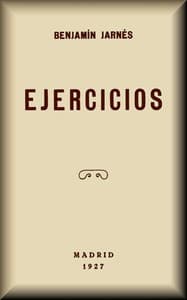
Benjamín Jarnés
Se abre en Project Gutenberg. Obra de dominio público vía Project Gutenberg.
Ejercicios by Benjamín Jarnés is a collection of literary aphorisms and critical mini-essays written in the early 20th century. The book explores the craft of writing and the aesthetics of modern art, arguing for precision, discipline, and luminous clarity in language. Across brief, numbered pieces, the author meditates on how thought demands exact words; rejects empty eloquence, cliché, and the “common style”; and champions a prose that is tight, rhythmic, and best read in a half-voice. He contrasts water and fire as images for artistic renewal, praises the image as a living instrument rather than a decorative trick, and urges cutting away rhetoric to reveal pure contour and pulse. He criticizes virtuosity without substance, distinguishes proscenium illusion from the naked test of the circus ring, and holds up models of economy and focus (such as Chaplin’s Charlot and Ramón Gómez de la Serna). He recasts the novel as a poem in motion, a frieze sustained by lyrical temperature rather than piled events, and reflects on the powers and limits of the aphorism. Later sections sketch kinds of poetry (of tension, form, music, or color), celebrate the child’s first astonishment, and end with a paradox: prose can be the enemy of thought and verse of the poem—unless the artist masters and transforms them. (This is an automatically generated summary.)
Jarnés, B. (s.f.) Ejercicios. https://www.gutenberg.org/ebooks/78679
Esta obra no tiene año de publicación, editorial en el catálogo, así que la referencia queda incompleta. Verifícala en la fuente original antes de usarla.
Los archivos BibTeX y RIS se importan en Zotero, Mendeley y gestores compatibles.